UNITED NATIONS
Thursday, July 2, 2015
Thursday, June 25, 2015
Soon as I Get Paid
Terrific West Coast Swing. Thanks Terry West
Ring a ling went the telephone
Is the man of the house at home?
Your master card is over due
Mr. Mo we need a payment from you
Right now, right now, right away
Look here
I ain't got nothing to send you today
But I'ma give you all your money
Soon as I get paid
Soon as I get paid
Well, now the joint was jumping
It was Saturday night
Her hair was long
And the dress was tight
I looked at her
She looked at me
And the champagne stared flowing
To a quarter to three, yeah yeah, oh yeah
To quarter to three
Look Mr Bartender
I'm gonna make it okay
I'll give you all your money
Soon as I get paid
Soon as I get paid
Monday morning, money gone
It's a dog gone shame
Don't worry, I get you straight, you'll be fine
You know what, you'll get yours, when I get mine
Uh, whoa, oh, got a letter from the IRS
Your tax return is a terrible mess
We want our money, we don't like to wait
Please come an see us on such and such date
Right now, oh yeah, right away
Well, I ain't got nothin' to send you today
But I'ma give ya all your money
Soon as I get paid
Yeah, soon as I get paid
Well, well, soon as I get paid
Thursday and Friday evening
Soon as I get paid
Better catch me before Monday
Soon as I get paid
Oh yeah, soon as I get paid
You heard me
Soon as I get paid
Soon as I get paid
Wednesday, June 24, 2015
Ethel Avenue
A LITTLE SPANISH-STYLED BUNGALOW IN THE SAN FERNANDO VALLEY
I lived in a great little house in North Hollywood with my family in the mid-1950's. It was adjacent to El Camino Real--the King's Highway--which linked the missions developed through California in the 1700's by the Franciscan Order of the Catholic Church. Leave it to my father to find an interesting home for us to live in.
The development of the valley was accelerating mid-19th Century, and two-story apartment houses abutted our place on two sides. There were still many vacant lots in the valley, however, and cities like Encino, Tarzana, North Hollywood and Studio City were distinct places along Ventura Blvd. with orchards or undeveloped land between them.
Here are the only pictures I have of that house and time..
I lived in a great little house in North Hollywood with my family in the mid-1950's. It was adjacent to El Camino Real--the King's Highway--which linked the missions developed through California in the 1700's by the Franciscan Order of the Catholic Church. Leave it to my father to find an interesting home for us to live in.
The development of the valley was accelerating mid-19th Century, and two-story apartment houses abutted our place on two sides. There were still many vacant lots in the valley, however, and cities like Encino, Tarzana, North Hollywood and Studio City were distinct places along Ventura Blvd. with orchards or undeveloped land between them.
Here are the only pictures I have of that house and time..
This was taken at the backdoor on my 9th birthday, I believe. As a nine year old kid would do, I'm proudly showcasing my rabbit's foot which is hanging from a belt loop.
(The damage to the photograph was done by my dog many years later)
We used the structures in the backyard alternately as "The Bank of Bud", and a chemistry lab.
This one, which was probably built and used as a chicken coop, became a puppet show theater.
Our dog Rusty won "The Homeliest Dog" award in a pet contest in Mill Valley a few years before this picture was taken of him in the driveway.
I think I had to pay my eldest brother 25 cents to take this photo (he caught the entrepreneurial spirit at an early age). I wanted a picture to send my grandparents in San Francisco. I combed my hair, donned a clean shirt and put a toy cigarette in my mouth in my best Humphrey Bogart impression.
A family picture (minus the bro behind the camera) taken around my mom's '52 MG. Not long after this, I was living with my grandparents in San Francisco.
I'm nostalgic, so you can imagine how chagrined I was when I visited North Hollywood fifty years later and found that my house and front yard had become a parking lot.
Even so, the backyard, where I spent many hours playing alone and with my brothers, had become a retail sculpture garden.
This is the view from Ventura Boulevard (El Camino Real).
It is a special place to me, and I'm glad that it has been preserved.
Tuesday, June 23, 2015
Monday, June 22, 2015
Sunday, June 21, 2015
James Robert Horton
In his later years, my stepfather told me of his experience during the assault of Okinawa during WWII. He was a Navy Signalman on a support ship. The ship next to him incurred a direct hit from a Japanese Kamikaze, which he witnessed from the signal deck. He told me how the sounds of battle moved from the shore and then inland over the course of a few days.
This is a Naval map of the ships involved in the assault. I brought it with me when I last visited him. I wanted to know about his life, but he left us that night.
Thursday, June 18, 2015
Sunday, June 14, 2015
June 14 in the Backyard
"The problem with owning a home is that wherever you look there's something you should be doing" ---Sam Ewing
Here are some pictures of my backyard minutes ago, and there are plenty of things I should be doing..
Saturday, June 13, 2015
Temple of Light Progress
The Baha'i temple in Santiago, Chile--the last continental Baha'i temple-- is nearing completion. The significance may be lost to the world, but not to me and Baha'is everywhere.
Friday, June 12, 2015
Thursday, June 11, 2015
Wednesday, June 10, 2015
Front Porch on San Luis Street
Josh's first room was in the front porch/sun room of Pederson's old house on San Luis Street. He'd watch people coming and going from the unemployment office next door. He remembers the street-sweeping machine that would drive by in the early mornings.
Here he is waking up sweaty after a nap. That room really warmed up in the afternoon.
Tuesday, June 9, 2015
Monday, June 8, 2015
Tug, the hunter..
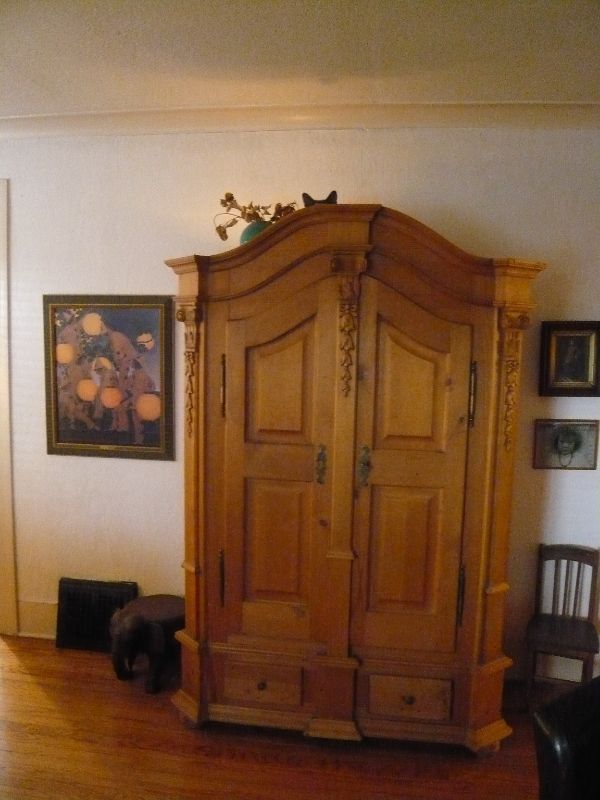
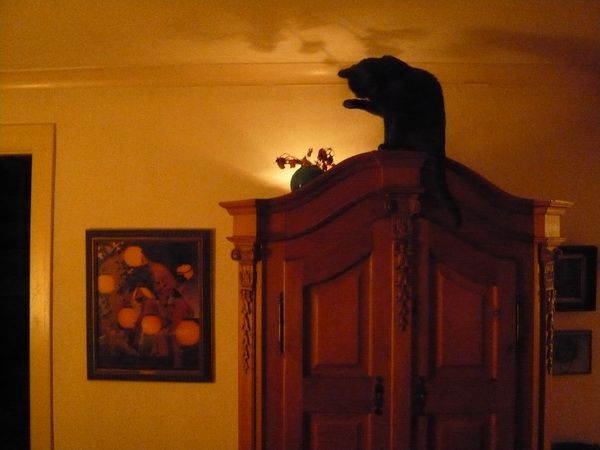
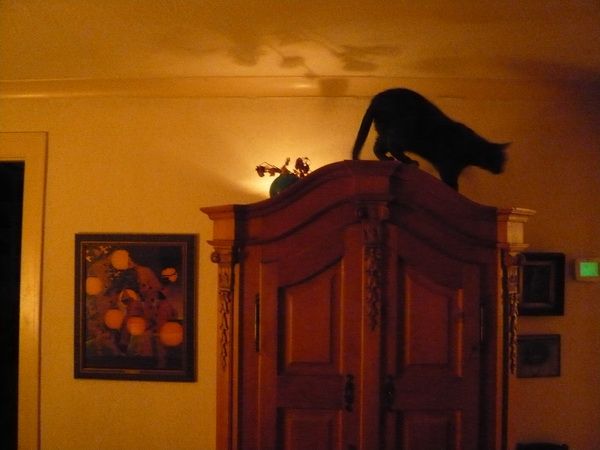
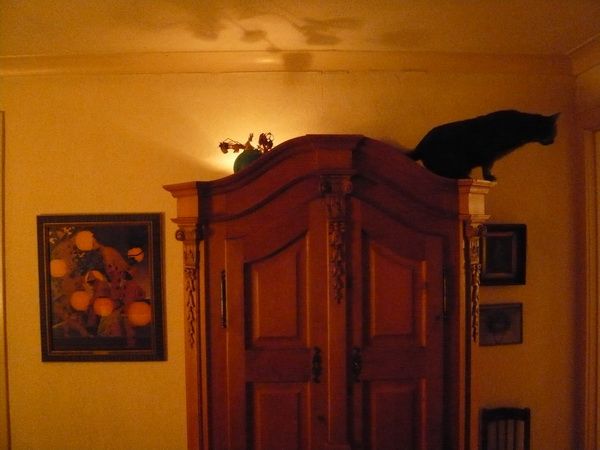
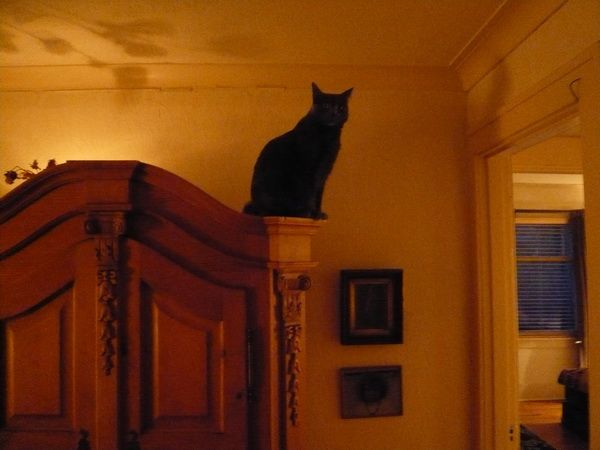
My cat Tug in the catbird seat

Tug has been watching birds through the windows. A few weeks ago he started jumping up on my armoire, and I'm pretty sure it was an instinctive response to seeing all that prey.
It would have been fine with me, but naturally he started pawing the vase and dried flowers, and I was sure he'd destroy them as cats are wont to do. I had a brainstorm: cats are very fussy about their coat and paws, so I bought a few 12" square floor tiles, took off the backing, and put them with the sticky-side up under and around the vase.
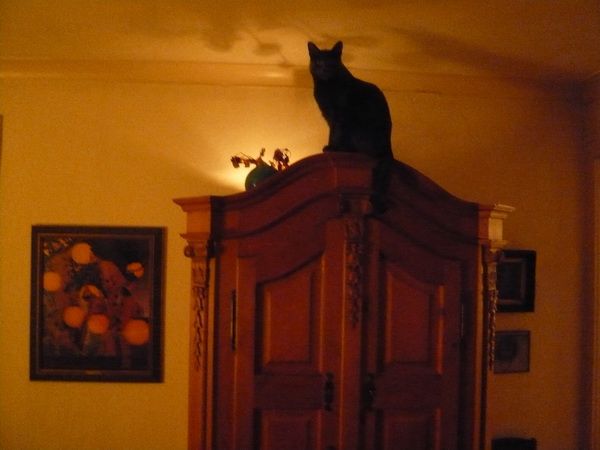
The next day I saw Tug had gotten on top of the armoire, and it looked like he was curious as to what I had done, so I grabbed my camera.

I caught the moment when he touched the sticky.

He contemplated what just happened.

And then guess what? He licked off the sticky.

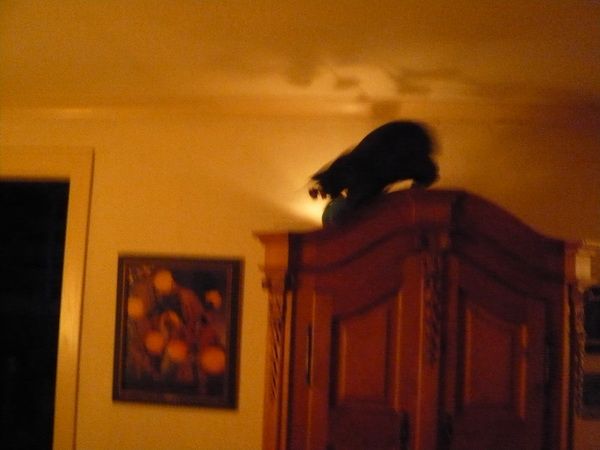
He decided to move to the other side...

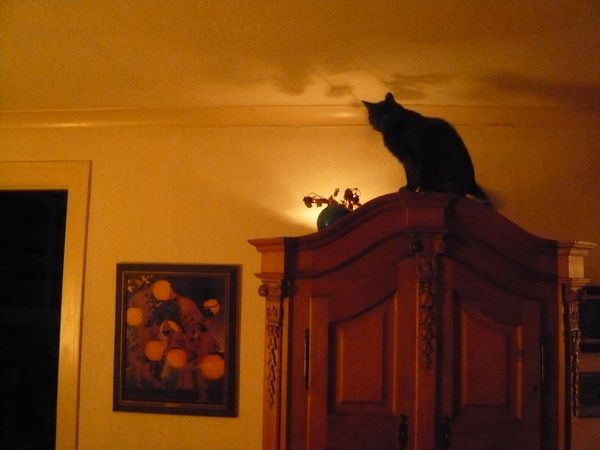
Waaay to the other side.

This is the moment he decided that the prospect of scattering some dried flowers and watching a vase smash on the floor wasn't worth the trouble.

Sunday, June 7, 2015
Thursday, June 4, 2015
Friday, May 29, 2015
Wednesday, May 27, 2015
Monday, May 25, 2015
Friday, May 22, 2015
BAHÁ'I HOLY PLACES
Bahá’ís believe that we are created beings by a God who is in essence unknowable and exalted above our understanding and comprehension. Our relationship is analogous to that of a painting to its painter. We learn of God and His Will through His Prophets, or Manifestations,who appear in the world in various ages and places. They serve as the brushes through which the will of the painter is expressed in the painting. They include Abraham, Moses, the Buddha, Krishna, Zoroaster, Jesus and Muhammad. These Manifestations perfectly reflect God’s holy nature by their exemplary and sanctified lives, and reveal God’s guidance through their words and laws.
This is a brief history of the two most recent Revelations.
♦
On May 22, 1844 in Shiráz, Persia, ‘Alí-Muhammad declared that he was a Manifestation of God, or a Divine Messenger, through whom God's Holy Will for this age was to be revealed. Assuming the name the Báb, or "Gate", He declared that He was also a Herald of the coming of another Manifestation of God soon to appear.

The Báb's claim that He was revealor of God's Word, like Jesus Christ and Muhammad before Him, attracted thousands of believers across Persia. It also raised the consternation of the Muslim clergy, who considered the Báb to be a heretic and a threat to their power and influence.

Responding to the feverish commotion that was sweeping Persia as word of the Báb's claim spread, and after the issuance of His Holy Book, the Bayán, the Shah sent his trusted and learned servant Vahíd to confront the Báb. After several interviews, Vahíd himself declared his belief in the station of the Báb, and along with twenty thousand other believers, was soon martyred by a fanatical populace which had been inflamed by the machinations of a self-serving Muslim clergy.
On July 9, 1850, in a public square in Tabriz, Persia, the Báb Himself was put to death by a volley from a firing squad comprised of seven-hundred and fifty men.

While imprisoned in Tehran for His allegiance to the Báb, it was revealed "in a dream" to Bahá'u'lláh, or "The Glory of God", that He was "The Promised One of All the Ages", and that He was the bearer of the "Most Great Revelation" to which "All the divine books and scriptures have predicted and announced unto men."
That this revelation was to be concealed from men for a period of nine years can only be attributed to the wisdom of God, for after His release from prison, Bahá'u'lláh was exiled to Baghdád, Iraq, and it was there that He left a greatly diminished number of the Báb's followers to live in solitude in the mountains of Kurdistán until "The Appointed Hour of His Return."

Upon His return from Kurdistán on March 19, 1856, Bahá'u'lláh became the spiritual center of the decimated ranks of the followers of the Báb, all the while concealing the fact that He was "The Promised One" the Báb had exhorted His followers to anticipate.
On April 22, 1863, in the Garden of Ridván, near Baghdád, Bahá'u'lláh announced to His followers His station and mission, and characterized that day as "The Day whereon the Tongue of the Ancient of Days hath spoken."
After twelve days of Revelation, Bahá'u'lláh, along with a certain number of His family and retinue, were exiled to Constantinople, Turkey, and from there to Adrianople, traveling this vast distance over the desolate Turkish landscape on foot and horseback with considerable privation.

In August, 1868, after five years in Constantinople and Adrianople, where Bahá’u’lláh had proclaimed His station in Addresses to the Kings and Rulers of the world, as well as to the religious leaders of Christiandom and Islám, Bahá’u’lláh was again exiled, this time to the prison-fortress of Akká, located on the shores of the Holy Land—the land “Promised by God to Abraham, sanctified by the revelation of Moses, honored by the lives and labors of the Hebrew patriarchs, Judges, Kings and Prophets, revered as the Cradle of Christianity, and as the place where Zoroaster…had ‘Held converse with some of the Prophets of Israel,’ and associated by Islám with the Apostle’s night-journey, through the Seven Heavens, to the Throne of the Almighty.” *
*Shoghi Effendi, ‘God Passes By’, p. 183

After more than nine years in the prison, wherein He had revealed, among numerous other writings, His “Most Holy Book”, the Kitáb-i-Aqdas, Bahá’u’lláh left Akká to reside at the Mansion at Bahjí, located a few miles from the prison. It was here that Bahá’u’lláh spent His final years, and on May 29, 1892, left this mortal realm.
Prior to His ascension, Bahá’u’lláh, to insure harmonious and continuous progress of the Faith after His passing, instituted a covenant, and designated His son, ‘Abdu’l-Bahá, as the Center of that covenant and sole interpreter of His teachings.

In 1909, the Sacred Remains of The Báb, which had been hidden for 49 years and carried in secret from Persia to Akká, were laid to rest on Mount Carmel, across the bay from Akká. A shrine was erected and, together with the Shrine of Bahá’u’lláh in Bahji, are the objects of pilgrimage to Bahá’ís around the world.
Additionally, the administrative headquarters of the Bahá’í Faith is located on Mount Carmel, which is in Haifa, Israel.

In April of 1912, after a voyage across the Atlantic, ‘Abdu’l-Bahá arrived in New York City, and began an eight month journey across the United States to proclaim the Revelation of Bahá’u’lláh.
On May 1, ‘Abdu’l-Bahá laid the cornerstone for the Bahá’í National House of Worship in Wilmette, Illinois, near Chicago. It is here that the Administrative Center of the Bahá’ís of the United States is located.

While in the United States, ‘Abdu’l-Bahá visited the gravesite of Thornton Chase, the first American Bahá’í. For Mr. Chase, ‘Abdu’l-Bahá reserved the Persian name “Sabet”(Steadfast) indicating his heroic and exemplary contribution to the establishment of the Faith in America. His grave is located in Inglewood, California.
Subscribe to:
Comments (Atom)